
Pre-Season Promise, Transfer-Window Questions, and Why This Still Feels Like a Very Brighton Season
There is something uniquely dangerous about a good Brighton pre-season.
Dangerous not in the football sense, but in the emotional sense. Dangerous because it encourages you to believe this might finally be the year you support Brighton in a calm, measured, emotionally sustainable way. Then a few sharp performances, a couple of clever signings and one big win at the Amex later, and suddenly you are pricing up European away days and convincing yourself the season ahead might be a lot of fun.
And to be fair, there is a lot to like.
Albion's pre-season has been genuinely encouraging. The football has looked sharp in spells, the squad still feels young, technical and well coached, and Fabian Hürzeler's team already seems to have more rhythm than most Brighton sides usually manage by this stage of the summer. There is enough here to be optimistic. There is also enough here to be a bit uneasy. Which, really, is the full Brighton experience.
The Pre-Season Has Been Properly Encouraging
Results in pre-season always come with a health warning, but they still tell you something. They tell you whether a side looks miles off it, whether the patterns are there, and whether the players seem to know what they are trying to be.
Brighton have looked like a team with a plan.
The 4-1 win over Wycombe was a good opening step. Babis Kostoulas scored twice, Ibrahim Osman added an overhead kick, and Georginio Rutter got himself on the scoresheet too. It was the sort of first run-out you want: lively, confident, and comfortably ahead of the usual July sluggishness.
Then came the slightly chaotic build-up to the training camp, with Albion having to switch from France to Austria at the last minute because of issues with the training pitches. In typical Brighton fashion, even the pre-season preparation had to come with a small logistical twist. Thankfully, it did not seem to derail anything.
If anything, the trip still looked productive. Albion beat Strasbourg 4-3 after going 2-0 down, with goals from Pascal Gross, Olivier Boscagli, Eiran Cashin and Ibrahim Osman turning the game around. Conceding three is not exactly ideal, but there was something reassuring about Brighton still having enough quality and personality to wrestle the game back when things got messy.
The standout performance, though, was Roma.
Brighton beat them 3-0 at the Amex and looked far more convincing than you would normally expect in a summer friendly against serious opposition. Yasin Ayari scored twice, Albion played with real intensity, and the whole thing had the slightly dangerous feel of a team making its supporters believe.
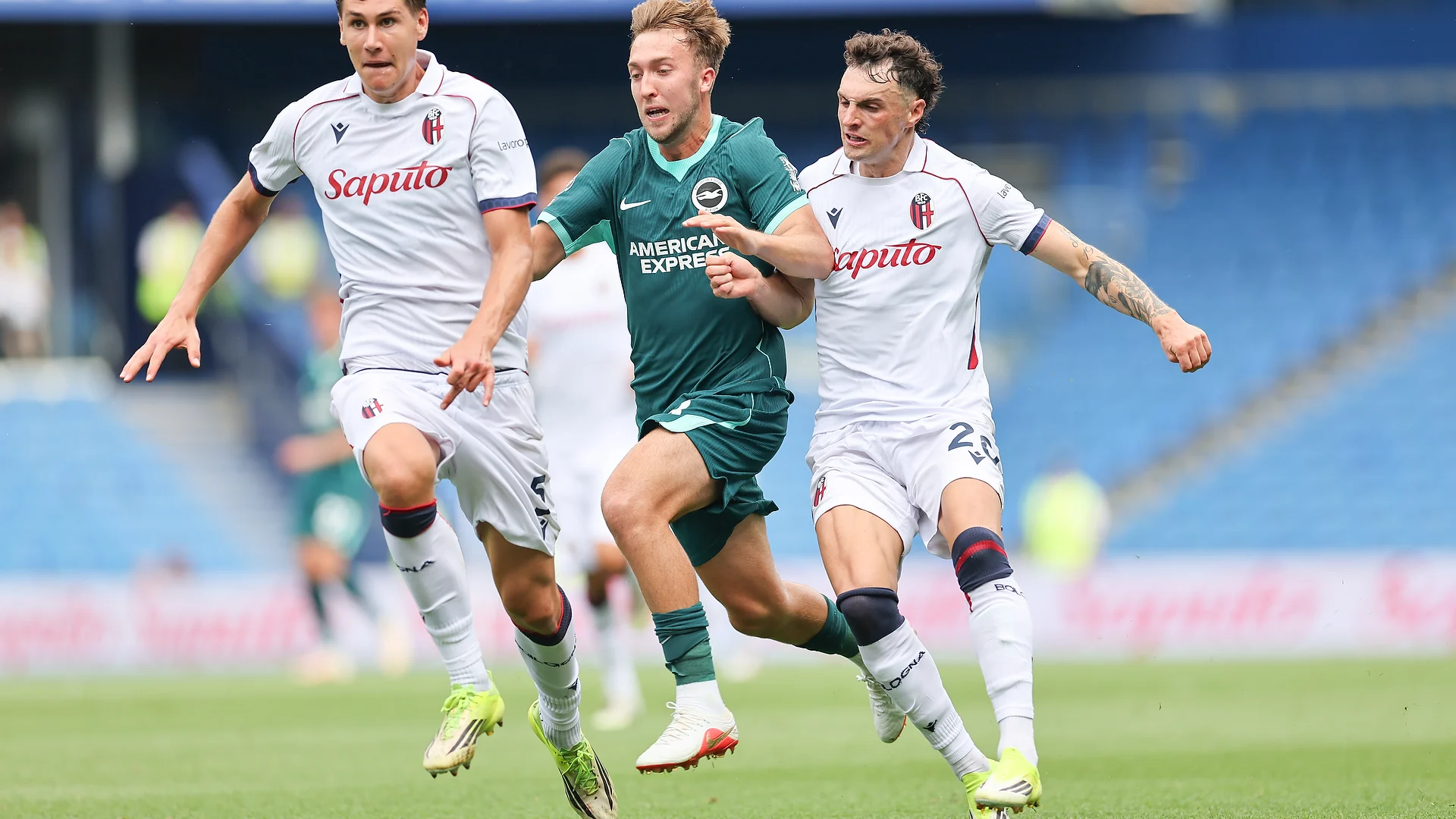
That was followed by a 1-0 win over Bologna, with Jack Hinshelwood scoring the goal in what felt like the ideal final tune-up. Another strong test, another positive result, another sign that Brighton are heading into the season in decent shape structurally — even if not quite in every position.
The Transfer Window So Far Feels Very Brighton
This has not been a flashy transfer window. It has been a Brighton one.
Costinha has come in from Olympiacos, Michael Svoboda has arrived from Venezia, and Zadok Yohanna has been picked up from AIK as another long-term project with obvious upside. Diego Gomez signing a new long-term deal also matters, because keeping players you believe in is just as important as finding the next one.
And then there is Luka Vušković, who definitely deserves mentioning here. He has looked good since arriving. There is a calmness to him already, and for a player still so young he does not seem remotely overawed by the level. It is early, obviously, and Brighton fans above all people should know better than to build monuments after a handful of pre-season appearances, but there is something there. He already looks like someone who could become a very serious player in this side.
That is the broad shape of the summer: smart recruitment, sensible age profile, good squad planning, and no wild departures from the model that has served the club so well for years.
On paper, it all makes sense.
But Brighton seasons are never played on paper, and this is where the concern starts creeping in.
The Biggest Worry Is the Attack
That is the area where the optimism around the summer starts to wobble a bit.
Danny Welbeck's departure to Chelsea is a significant loss, not just because of goals, but because of everything else. His movement, his experience, his link play, his leadership, his ability to calm things down when attacks got scrappy — all of that matters, especially in a squad that is still relatively young and now heading into a season with European football attached.
And the problem is that Brighton do not just feel lighter in attack because Welbeck has gone. They feel lighter because the options there already look uncertain.
Yankuba Minteh picking up an injury against Roma and now being expected to miss two to three months is a big blow. He is exactly the sort of direct, aggressive wide threat Brighton need, especially in a side that can sometimes dominate possession without always turning it into enough damage. Losing him for that length of time is not a minor inconvenience — it changes the balance of the forward line straight away.
Then there is Rutter. He is not injured, which is important, but he still does not look especially comfortable as the number 9. There is a very good footballer there, and he can absolutely influence games, but there is a difference between being an attacking threat and looking like the natural focal point of the line. Right now, he still seems more like a player you want involved around the striker rather than one you want carrying the entire central burden himself.
That is what gives the attacking concerns a bit more weight. It is not just that Brighton have lost Welbeck. It is that they have lost him at a moment when the rest of the attack does not feel fully settled, fully fit, or fully defined.
Europe Is Back — And It's Tromsø
Now that the draw is settled, the season suddenly feels very real.
Brighton will face Tromsø in the Conference League play-off, and that brings both excitement and pressure in equal measure. European football at the Amex still feels like one of those things supporters should never take for granted, and there will be a proper sense of occasion around it.
But it also sharpens the concern.
A two-legged European tie asks questions of your squad immediately. It asks whether you have enough options, enough goals, enough freshness, enough certainty in key areas. Brighton may well have enough to get through it, but it is hard to ignore the fact that one of the main areas of uncertainty just happens to be the attack.
That feels very Brighton: the thrill of Europe arriving hand in hand with a mild sense of dread about who is actually fit enough to lead the line.
What to Expect From the Season Ahead
The optimistic view is easy enough to see.
Ayari looks ready to matter more. Hinshelwood feels increasingly central to what this team is becoming. The structure is there. The coaching is there. Brighton still look like a side with a proper football identity rather than just a collection of decent players. When they click, they look very good.
But the caution is obvious too.
European football means more games, more rotation, more strain, and less room for uncertainty. Brighton can absolutely have a good season, but they do not feel like a side with loads of margin for error in the attacking areas. If the goals are spread around and a couple of players step up quickly, fine. If not, the loss of Minteh for a chunk of the early season could become a real problem.
That probably makes the next few weeks of the transfer window quite important. Because while the business so far has been smart, it still does not quite feel finished. Not if Brighton want to enter a Premier League and European campaign without that nagging sense that they are one or two attacking options short.
Final Thought
So where does that leave us?
Pretty much where Brighton fans usually are: encouraged, impressed, but not entirely convinced everything is sorted.
The pre-season has been strong. The football has looked promising. The transfer business has made sense. Tromsø gives the club and the supporters another big European occasion to look forward to.
But there is a very real concern up front now, and it is hard to ignore it.
Welbeck has gone. Minteh is out for a significant spell. Rutter is available, but still does not really look like a natural number 9. Then beyond that, the options start to feel even less certain. Stefanos Tzimas is still working his way back from a serious long-term injury. Evan Ferguson is also returning from injury, and even aside from fitness, his long-term future at the club still feels far from clear. Then there is Babis Kostoulas, who has shown flashes in pre-season, but Fabian Hürzeler does not yet seem convinced he is ready given how limited his minutes have been.
That is what makes the attack feel like the part of the squad that could shape Brighton's entire season. There is talent there, definitely. There is potential there too. But right now there is not much that feels settled, reliable, or fully proven. And when you are about to juggle Premier League football with Europe, that uncertainty starts to matter very quickly.
Which is probably the most Brighton conclusion possible.
There is every reason to be excited.
And every reason to keep glancing nervously at the team news while you do it.